

会计档案移交清册须永久保存。()
【不定项选择题】


对该气体灭火系统进行维护保养,下列做法不符合要求的有( )。
A.
每年对其中一个防护区进行1次模拟喷气试验
B.
每季度对防护区的开口是否符合设计要求进行一次全面检查
C.
每季度对灭火剂和驱动气体储存容器内的压力进行一次全面检查
D.
每季度对各喷嘴舒孔口有无堵塞进行一次全面检查
E.
每季度对灭火剂储存容器及容器阀等组件外观是否完好、铭牌和标志牌是否清进行一次全面检查

手机使用

微信扫一扫
分享
参考答案

参考解析
【不定项选择题】
【背景资料】
某堤防工程项目业主与承包商签订了工程施工承包合同。合同中估算工程量为5300m³,单价为180元/m³。合同工期为6个月。有关付款条款如下:
(1)开工前业主应向承包商支付签约合同总价20%的工程预付款;
(2)当累计实际完成工程量超过估算工程量的10%时,可对超出10%部分进行调价,调价系数为0.9;
(3)每月签发付款最低金额为15万元;
(4)工程预付款从乙方获得累计工程款超过签约合同价的30%以后的下一个月算起,至第五个月均匀扣除;
(5)本工程质量保证金在合同工程完工验收后,通过延长履约保函一年担保。
承包商每月实际完成并经签证确认的工程量见表1F420140-4。
【不定项选择题】
4"展览厅内消防应急疏散标志灯具未亮,分析造成上述现象的原因,不能排除的有( )。
消防应急疏散标志灯具损坏
火灾报警控制器故障
消防应急疏散标志灯具控制线路故障
消防应急疏散标志灯具配电线路故障
应急照明控制器故障
【不定项选择题】
某公路工程,合同价4000万元,合同工期270d。合同条款约定:①工程预付款为合同价的10%,开工当月一次性支付;②工程预付款扣回时间及比例:自工程款完成(含已支付的工程预付款)至合同价款的60%的当月起,分两个月平均扣回;③工程进度款按月支付;④工程质量保证金按月进度款的5%扣留;⑤钢材、水泥、沥青按调值公式法调价,权重系数分别为0.2、0.1、0.1,其中钢材基期价格指数为100。施工合同签订后,施工单位向监理提交了如下图所示的进度计划,并得到监理批准。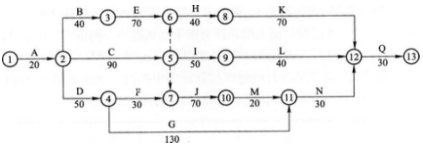
前6个月(即1~6月份)每月完成的工作量见下表: 6月份钢材的现行价格指数为110,其余材料价格无变化。施工过程中,在第三个月末检查时发现:E工作延误20d,C工作延误10d,F工作按计划进行,G工作提前10d。为满足业主坚持按合同工期完工的要求,在不改变网络计划逻辑关系的条件下,施工单位根据下表按照经济性原则进行计划调整。
 在G工作进行到一半左右,出现了合同中未标明的硬质岩石,导致施工困难。施工单位及时采取合理措施进行处理并通知了监理。因处理硬质岩石导致增加费用20万元、G工作延误20d,对此,施工单位在规定时间内提出了工期及费用索赔。
【不定项选择题】
某年4月至10月中旬,一心想靠林木发财的金某看着贵州坑木价格一天天上涨,便利用宣威市普立乡半坡村地处边远山区、执法人员不易发现之便,11次指使当地群众盗伐云南松1200棵,制成2.2米长的坑木。然后,金某以每根9元或10元的价格进行收购。接着,金某又以每根X元钱的运费交由驾驶员陈某用农用车运往贵州省水城县,在该县都格乡煤矿出售。该乡煤矿矿长罗某和收木员李某则以每根12元、13元、15元不等的低于市场价的价格非法收购,用作煤井坑木。以下说法中哪些是正确的?( )
金某构成非法收购、运输盗伐林木罪
陈某构成非法运输盗伐林木罪
金某构成盗伐林木罪
罗某、李某构成非法收购盗伐林木罪
【不定项选择题】
It was only after I started to write a weekly column about the medical journals, and began to read scientific papers from beginning to end, that I realized just how bad much of the medical literature frequently was. I came to recognize various signs of a bad paper: the kind of paper that purports to show that people who eat more than one kilo of broccoli a week were 1.17 times more likely than those who eat less to suffer late in life from pernicious anaemia. (46) There is a great deal of this kind of nonsense in the medical journals which, when taken up by broadcasters and the lay press, generates both health scares and short-lived dietary enthusiasms.
Why is so much bad science published? A recent paper, titled ‘The Natural Selection of Bad Science’, published on the Royal Society’s open science website, attempts to answer this intriguing and important question. It says that the problem is not merely that people do bad science, but that our current system of career advancement positively encourages it. What is important is not truth, but publication, which has become almost an end in itself. There has been a kind of inflationary process at work: (47) nowadays anyone applying for a research post has to have published twice the number of papers that would have been required for the same post only 10 years ago. Never mind the quality, then, count the number.
(48) Attempts have been made to curb this tendency, for example, by trying to incorporate some measure of quality as well as quantity into the assessment of an applicant’s papers. This is the famed citation index, that is to say the number of times a paper has been quoted elsewhere in the scientific literature, the assumption being that an important paper will be cited more often than one of small account. (49) This would be reasonable enough if it were not for the fact that scientists can easily arrange to cite themselves in their future publications, or get associates to do so for them in return for similar favors.
Boiling down an individual’s output to simple metrics, such as number of publications or journal impacts, entails considerable savings in time, energy and ambiguity. Unfortunately, the long-term costs of using simple quantitative metrics to assess researcher merit are likely to be quite great. (50) If we are serious about ensuring that our science is both meaningful and reproducible, we must ensure that our institutions encourage that kind of science.
【不定项选择题】
World War II was the watershed event for higher education in modern Western societies. (46) Those societies came out of the war with levels of enrollment that had been roughly constant at
3-5% of the relevant age groups during the decades before the war. But after the war, great social and political changes arising out of the successful war against Fascism created a growing demand in European and American economies for increasing numbers of graduates with more than a
secondary school education(47) And the demand that rose in those societies for entry to higher education extended to groups and social classes that had not thought of attending a university before the war. These demands resulted in a very rapid expansion of the systems of higher education, beginning in the 1960s and developing very rapidly (though unevenly) during the 1970s and 1980s.
The growth of higher education manifests itself in at least three quite different ways, and these in turn have given rise to different sets of problems. There was first the rate of growth: (48) in many countries of Western Europe,the numbers of students in higher education doubled within
five-year periods during the 1960s and doubled again in seven, eight, or 10 years by the middle of
the 1970s. Second, growth obviously affected the absolute size both of systems and individual institutions. And third, growth was reflected in changes in the proportion of the
relevant age group enrolled in institutions of higher education.
Each of these manifestations of growth carried its own peculiar problems in its wake. For example, a high growth rate placed great strains on the existing structures of governance, of administration, and above all of socialization. When a faculty or department grows from, say, five to 20 members within three or four years, (49) and when the new staff are predominantly young men and women fresh from postgraduate study, they largely define the norms of academic life in that faculty. And if the postgraduate student population also grows rapidly and there is loss of a close apprenticeship relationship between faculty members and students, the student culture becomes the chief socializing force for new postgraduate students, with consequences for the intellectual and academic life of the institution—this was seen in America as well as in France, Italy, West Germany, and Japan. (50) High growth rates increased the chances for academic innovation; they also weakened the forms and processes by which teachers and students are admitted into a community of scholars during periods of stability or slow growth. In the 1960s and 1970s, European universities saw marked changes in their governance arrangements, with empowerment of junior faculty and to some degree of students as well.
【不定项选择题】
甲公司为增值税一般纳税人,主要从事货物运输、装卸搬和仓储服务。2019年9月有关经营情况如下:
(1)提供货物运输服务,取得含增值税价款2180000元,同时收取包装费10900元。
(2)提供装卸搬运服务,取得含增值税价款41200元。
(3)提供仓储服务,取得含增值税价款82400元。
(4)出租一间闲置仓库,取得含增值税租金52500元,该仓库系甲公司2006年购入。
(5)采取预收款方式向乙公司出租1辆纳入“营改增”试点之日起取得运输车辆,9月16日签订有形动产租赁合同,租期3个月。9月20日收到乙公司支付的租赁费,9月23日向乙公司开具增值税专用发票,9日28日向乙公司付出租的运输车辆。
(6)将资金贷与关联企业丙公司使用,取得利息150000元。
(7)无偿为关联企业丙公司提供仓储服务,同类仓储服务含增值税价款1090元。
(8)因公司车辆发生交通事故,获得保险赔付200000元。
(9)取得存款利息1750元。
已知:销售交通运输服务增值税税率为9%
要求:根据上述资料,不考虑其他因素,分析回答下列小题。
1.计算甲公司当月提供货物运输服务增值税销项税额的下列算式中,正确的是( )。
2180000 × 9%=196200(元)
2180000 ÷(1+9%)x9%=180000(元)
(2180000+10900)÷(1+9%)x9%=180900(元)
(2180000+10900)×9%=197181(元)